
The story of the Instow Sand Action Group and Instow Sands CIC, past and present.
How Instow is tackling the drifting sand, building a community along the way.
 Donate now
It was at the beginning of 2024 that an Instow resident, Jacqui Poole, first attempted to address the problem of sand building up on the pavement and road on the beach front in Instow. Sand had blown over the sea wall due to the high level of the beach, and the road had flooded owing to sand blocking the drains; in fact the errant sand was causing havoc for residents, pedestrians and traffic alike. What initially appeared to be a straightforward issue to fix soon revealed itself to be far more complex, involving several different agencies each with their own responsibilities and constraints.
Jacqui wrote an article in the Parish Magazine bemoaning the lack of action on the part of ‘those responsible’ for the ubiquitous existence of sand on the highway and pavement. “I’d been dog-walking,” Jacqui said, “and asking myself how ‘they’ could have let it get so bad. The idea then came to me that perhaps complaining wasn’t the answer — perhaps we, the community, should do something about it.”
Her research revealed that there were not just one, but numerous agencies that governed the siting of sand on the beach. Instow had become part of the Taw–Torridge Site of Special Scientific Interest (an SSSI) in 1988 and fell under the governance of North Devon’s UNESCO Biosphere, which in turn is governed by the Biosphere Reserve Partnership; this Partnership is controlled by a core management group, ensuring that UNESCO’s standards are met.
The Biosphere Reserve Partnership is made up of a diverse coalition of approximately 35 members, which include:
Jacqui Poole, Carolyn Maynard and several other residents attended an Instow Parish Council meeting where they were given a brief time to speak about the sand issue and to request funds, but they were unsuccessful. They realised that, due to the many agencies involved, they could not tackle the issue alone. They devised a sign-up sheet which gave a brief outline of the sand issue; this was delivered to the various restaurants and pubs in Instow, and a good number of supportive residents signed up, which enabled Carolyn and Jacqui to make contact with people who were willing to get involved.
The meetings were informal at first, gathered round Carolyn’s cosy kitchen table, but soon they realised that to progress they needed to form a more structured group. Carolyn and Jacqui were asked to lead as chair and secretary, and so the Instow Sand Action Group was born. This created a more formal body to communicate with the various agencies involved in tackling the sand issue. Members regularly attended Parish Council meetings to raise ongoing concerns and represent the interests of residents affected by the sand. “It was a pretty intense time,” said Jacqui, “but quite exciting and rewarding as well.”
The group learnt that the majority of the beach was owned by Christie Devon Estates, and they also discovered that North Devon County Council had responsibility for keeping the pavements and roads safe for pedestrians and drivers, but the Council were unable to return sand to the beach once it had reached the pavement and roads, as it was deemed to be ‘contaminated’. The Biosphere under UNESCO had very strict guidelines, and with so many bodies involved it was becoming a minefield.
The Parish Council had, of course, been ‘on the case’ well before this, but what Jacqui and Carolyn and the Sand Action Group had, which Instow Parish Council were short of, was time to engage more fully with this particular challenge, while the Parish Council had, and still have, plenty of other issues to attend to.
Over a period of months through 2024, letters and emails were sent to Natural England in an attempt to find a compromise which would allow sand to be placed back on the beach. They were followed up by Carolyn and Jacqui meeting with Andrew Woollacott, manager for Christie Estates. He formally applied to Natural England for a licence to move the sand from the pavements and roads back onto the beach (a licence was a pre-requisite before any movement of sand could take place). Progress was slow and sometimes felt uphill, but progress was indeed being made, and their hard-fought lobbying was yielding results.
In January 2025 Instow hit the headlines when the TV news programme Spotlight featured the trials and tribulations of Instow’s sand issues; this helped to raise awareness further afield and to put the spotlight, so to speak, on Instow’s plight.
In July 2025 the licence to move sand back onto the beach and, most significantly, to re-site the sand away from the wall, was granted for one year. However, the elephant in the room had to be faced: moving vast amounts of sand costs money, and a lot of it!
The Royal Marines from the Amphibious Vehicle Training camp in the village were approached, and they agreed to help with the massive task of relocating the sand on the beach — not only as part of their mission to support the community, but also as an opportunity to train their recruits, all at a minimal cost. This cut the enormous price of lowering the sand levels by the beach wall to a manageable amount, and with funding from both Instow Parish Council and Christie Estates the task became possible.
With licence in hand, work got under way. The Royal Marines, together with local residents and some hired help, managed to partially complete the vital task of re-siting sand from the sea wall to a designated area specified by Natural England — a sterling effort, but more work was required.
At this time a substantial personal and collective investment had been made, and the figures below give an idea of the costs that were involved:
As a backcloth to all of this, and once the licence had been granted, the Instow Sand Action Group became worthy of its name in another role, by creating a sand clearance programme. They organised once-monthly work parties, and on the first Saturday of the month, armed with shovels, wheelbarrows and brooms, teams of committed locals set about relocating sand from the pavements back onto the beach. The workers were plied with bacon butties and refreshments afterwards, initially donated by the Wayfarer Inn and subsequently by The Glorious Oyster.
Is it ‘bows and arrows against the mighty’? The pavements may not have been perfectly sand-free, and they knew they would not stay sand-free, but the work not only created clearer pavements, it created a community spirit — in fact it was community-building at its very best, and long may it last!
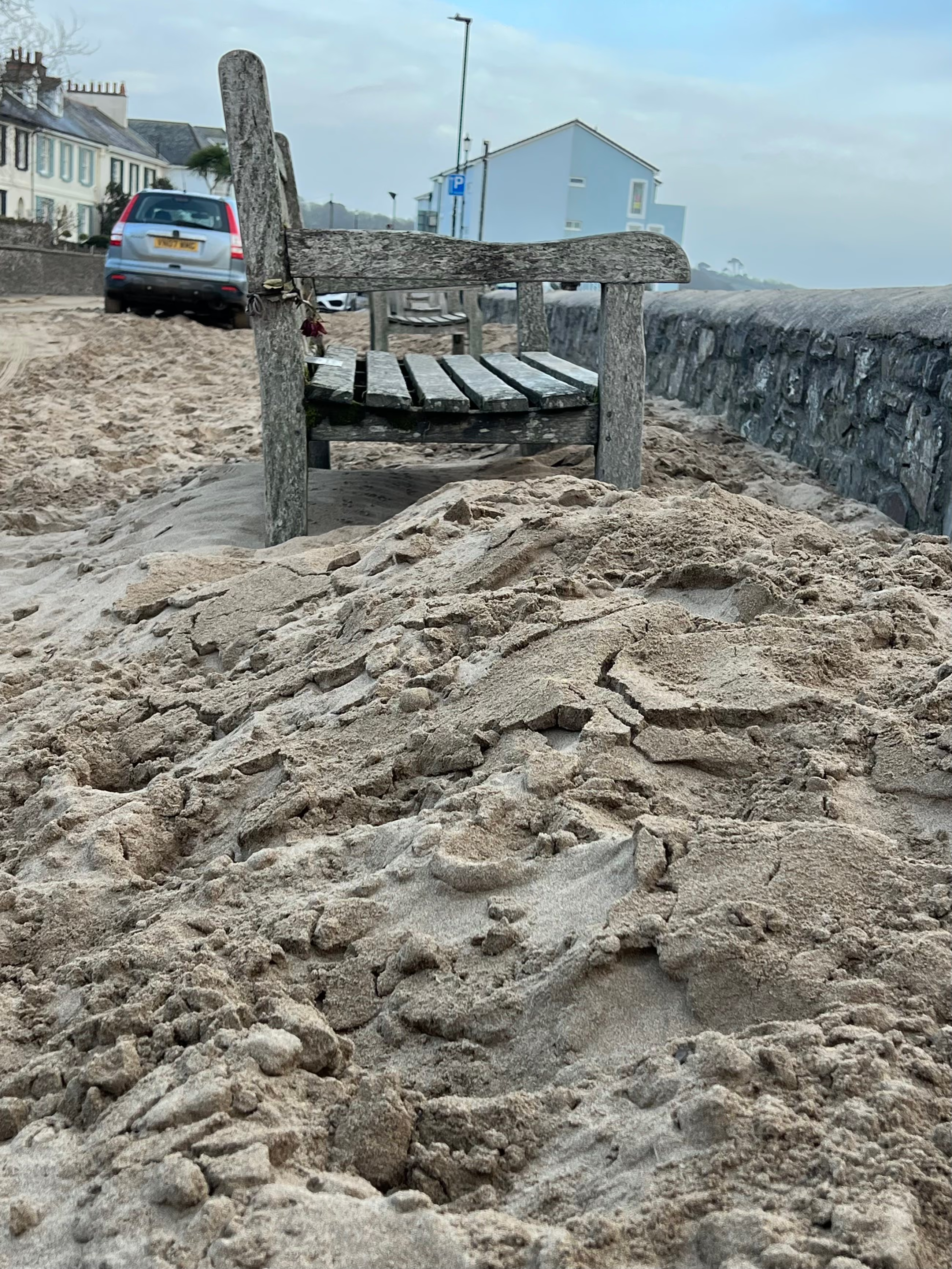
With storms and strong onshore winds battering the estuary during the winter of 2025 and spring of 2026, it was impossible for the Sand Action Group working parties to keep on top of the relentless mounds of sand smothering benches, pavements and roadways, and with no ongoing beach maintenance the sand levels began to rise again. The sand was literally falling over the sea wall, making it easy for it to blow over onto the road and pavement. In fact, at many points it was possible to step from pavement to beach over the wall without a drop.
Pedestrians walking along the sea front were continually battered by painful sand storms whipped up from the beach, and seafront residents lost the battle to sweep the constant tide of sand from their drives and gardens. Wheelchair users were risking their lives amongst the road traffic to navigate the deep sand drifts on the pavement, and mums with prams were seen running and dodging round parked cars as the pavement had become impassable.
In February 2026 the Sand Action Group called an open meeting, kindly hosted by The Commodore Hotel with coffee and cake as an enticement to attend. It was an opportunity for the local community to be brought up to date, to share ideas and to discuss any strategy that might achieve the almost impossible, and time was running out as the licence was due to expire at the beginning of July ’26. Jacqui Poole, who had formed and spearheaded the group from the very beginning, felt it was time to step back from her role, having got the ball well and truly rolling — but this has not diminished her enthusiasm for the end goal of sand-free pavements in Instow.
During the Commodore meeting, an idea was put forward to form a Community Interest Company, which would give the Sand Action Group a corporate structure and enable them to apply for grants and raise much-needed funds within a not-for-profit framework. A March meeting, held once again in Carolyn Maynard’s cosy kitchen, firmed up the plan to form the not-for-profit company named Instow Sands CIC.
Funding was indeed the main stumbling block to moving forward, and the matter was brought up at Instow Parish Council meetings where Carolyn Maynard lobbied for the Council to help fund the work. The Parish Council were all too aware of the sand issue, and that something had to be done urgently.
Eventually, in spring 2026, Instow Parish Council again secured some funding from the beach owners, Christie Estates, and the Parish Council agreed to match it. Volunteers offered their time and equipment once again, and permission was granted for the urgent sand-moving work to begin before the licence expired.
The 4th of June 2026 was the first day of a mammoth three-day sand-moving marathon. Apart from the unstinting generosity of local businesses and farmers, and the supreme hard work of both volunteers and the hired workforce, what cemented its success was that Chris Hopkins, member of the Sand Action Group and Instow Parish Council, had managed to engage the wonderful Royal Marines to come to our aid for a second time. Thousands of tons of sand were re-sited from the beach wall to the foot of the sand dunes, creating a significant drop from pavement level to the surface of the sand of some 6ft in places, uncovering drain outlets and rediscovering the half-way stone steps onto the beach. It is hoped that this will, to some extent, alleviate the progression of sand onto the highways.
Huge progress may have been made through June 2026, but now is not the time to rest on our laurels; what is needed, of course, is a long-term plan. Strategies have been tried before to find a way of preventing sand from invading the highway and our drains — artificial dunes were created in 2020 to try to prevent this, but the scheme was unsuccessful, and ideas of selling the excess sand were quashed, as the Biosphere prevents the removal of any material from the beach.
A report in 2010 named The Instow Sand Management Proposal stated that if we were to ‘just let nature take its course’ the dunes would spread southwards along the sea front, swamping the pavements, roads and residential gardens in sand. This would clog up drains, which would in turn create severe flooding. There would be no beautiful view across to Appledore from the front, and local businesses would suffer; roads and pavements would become permanently unusable for vehicles and pedestrians, eventually leaving residents stranded in the middle of a desert. This is clearly not the answer for the community.
What happens next is, to some extent, in yours and our hands. We can, and should, continue to lobby, to ask questions and to press for action as a community, while also doing what we can practically to keep sand off the highway. As of May 2026, the beach levels have been returned to where they were some years ago, but we need to maintain them, and this costs.
The increasing frequency of storms and high winds means increased expenditure — hiring the necessary heavy machinery costs in the region of £1,500 per day — so if we are to achieve our shared aim of working constructively with the relevant agencies to keep beach levels below the drain outlets, then we need your help to raise funds to maintain all the hard work undertaken so far.
We urge everyone to consider the critical importance of this project, not just as a short-term fix but as an ongoing commitment to the wellbeing, safety and sustainability of Instow’s community.
We don’t know exactly when the storms are coming again to blow the sand back onto the roads, but we do know they will come, so let us pull together to safeguard Instow for all who live and work here, and for all those who wish to enjoy this beautiful place, now and in the years to come.
If you feel you can contribute — whether financially, by helping to organise activities, or by joining one of our work parties — we would be very glad to hear from you.
Help us keep funding the work that strengthens our community and keeps Instow safe for everyone to enjoy.
Questions, ideas, or want to volunteer? We would be glad to hear from you.